
Enteric Fever (Typhoid Fever and Paratyphoid Fever)
Key points
-
Enteric fever is an acute, life-threatening, febrile infection caused by Salmonella enterica serotypes Typhi, Paratyphi A and Paratyphi B.
-
Worldwide incidence varies, with highest burden in South Asia; 23 countries are considered endemic (>100/100,000 person-years). Children <5yo accounted for 40% of deaths.
-
The source of infection is food and water contaminated by the feces and urine of an acutely infected person or chronic human carrier.
-
Immigrants and refugees from Southern Asia are at highest risk of enteric fever. They are also at higher risk of multi-drug-resistant infection. Resistance to ciprofloxacin can be high and ceftriaxone resistance is emerging.
-
Diagnosis is made clinically and by culture. Fever with or without abdominal pain is the most common presenting symptom. Diarrhea is often absent and constipation can predominate. No reliable serological tests are commercially available in Canada. The diagnostic yield in blood culture is highest with increased blood volume sampling. In the acute phase of illness, blood culture is of superior diagnostic yield to stool culture.
-
Specific antibiotic therapy shortens the clinical course of enteric fever and reduces the risk of death.
-
Comprehensive treatment advice for children can found at: Salmonella infections in Canadian children | Canadian Paediatric Society.
-
Public health notification is required. Restrictions on childcare attendance (children and staff) and food handling are regionally mandated.
Introduction
Enteric fever is an acute, life-threatening, febrile infection caused by Salmonella typhi (typhoid fever) or S. paratyphi (paratyphoid fever). It is transmitted by food and water contaminated by the feces and urine of an acutely infected or convalescent person or a chronic asymptomatic carrier.
Epidemiology
Worldwide, approximately 9.3 million cases are reported each year with an estimated mortality of 1.50/100,000 person-years (0.78–2.54) or 107,500 death/year. Mortality is highest among children, peaking from 12 to 23 months of age and therefore can be concerning in young newcomers to Canada and travellers returning from high-risk areas.[1] Increases in mortality rates has been linked to antimicrobial resistance.
Risk factors
Those at risk of infection include newcomers to Canada from a high-risk area who have recently arrived (within the past 3 months) or a recent traveller to a high-risk area. Enteric fever is more common in areas of the world that have inadequate water and sanitation systems. Epidemiologic data suggests that highest-risk areas include South Asia, along with South-east and Central Asia, and Sub-saharan Africa (see Figure 1).[1] A history of typhoid vaccination does not eliminate the risk of infection because vaccine protection is limited (50% to 80%).[2]
Figure 1: Geographical distribution of typhoid fever.
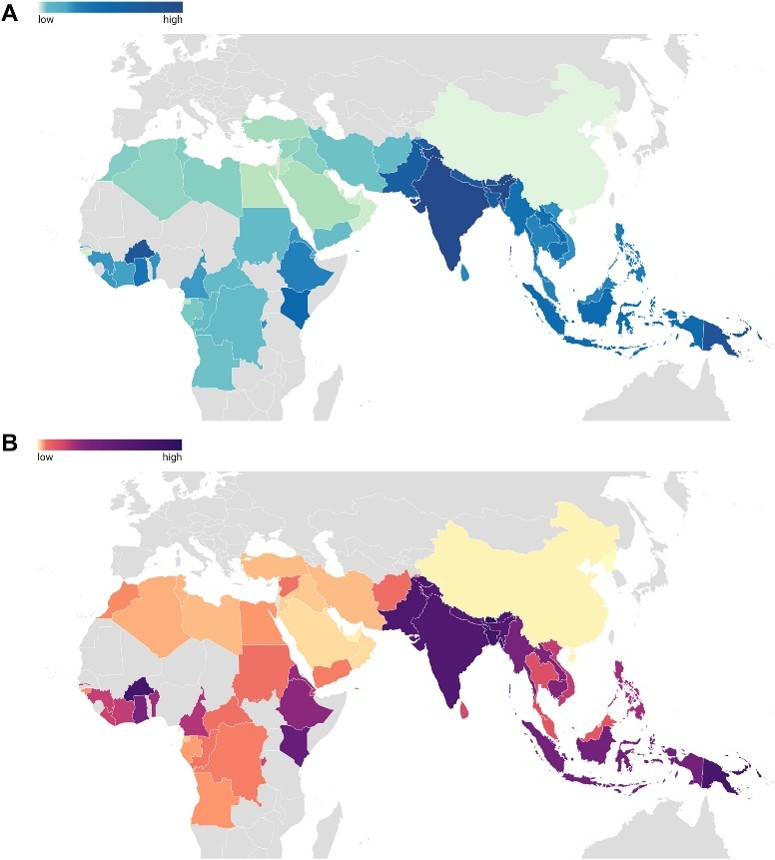
Source: Piovani D, Figlioli G, Nikolopoulos G et al. The global burden of enteric fever, 2017–2021: a systematic analysis from the global burden of disease study 2021. eClinicalMedicine, 2024; 77
It is uncommon for children to become asymptomatic chronic carriers following acute typhoid infection. If personal hygiene is poor, a chronic carrier may pose a risk for transmission to others. A chronic carrier is an individual who excretes S. typhi in stools or urine (or has repeated positive bile or duodenal string cultures) for over 1 year after onset of acute typhoid fever.
Clinical clues
The clinical presentation of enteric fever is non-specific, ranging from mild illness (low-grade fever, malaise, sometimes a slight dry cough) to severe illness (severe abdominal pain, serious complications).[3],[4] The incubation period depends on the infecting dose. The usual range is 1 to 3 weeks but incubation can vary from 3 days to 3 months.
Clinical signs of enteric fever include:
-
Sustained fever to 40°C
-
Malaise
-
Abdominal pain
-
Constipation or diarrhea
-
Severe headache
-
Change in mental status
-
Evanescent rose spots (blanching, erythematous, slightly raised lesions, especially on the trunk)
-
Hepatomegaly
-
Splenomegaly
-
Dactylitis
Severity of infection
Complications of enteric fever usually occur during the second or third week of illness in 10% to 15% of patients. Life-threatening intestinal hemorrhage and intestinal perforation may occur in 3% of hospitalized patients with typhoid fever. Meningitis and endocarditis are rarer complications. Patients who have thalassemia or glucose-6-phosphate dehydrogenase deficiency (G6PD) may have hemolysis during typhoid fever.
A number of factors can affect the severity and outcome of enteric infection:[4]
-
Duration of illness before treatment
-
Choice of antimicrobial treatment
-
Age
-
Previous exposure
-
Typhoid vaccination history
-
Virulence of the bacterial strain
-
Quantity of inoculum ingested
-
Patient characteristics, such as human leukocyte antigen (HLA) type, immunosuppression (e.g., HIV), haemoglobinopathies (e.g. sickle cell anemia)
-
Medications that diminish gastric acid (e.g., H2 blockers, antacids)
Diagnosis
Diagnosis should be considered in all febrile children who have travelled to or come from endemic areas within the past 3 months.
The best way to diagnose enteric fever is by collecting several large-volume blood cultures early in the disease. A single blood culture is positive in only half of cases. At least one stool sample should be sent for bacterial culture and sensitivity (yield is 30% to 50%). Urine culture has the lowest yield.[5] Urine culture may be helpful in immigrant and refugee children who have a history of Schistosoma hematobium or tuberculosis infection of the urinary tract, which may predispose them to chronic urinary carriage after typhoid fever. Occasionally, bone marrow aspirate for culture may be necessary (yield is 90%). Leukopenia may be found.
The Widal test is a serologic assay for detecting immunoglobulins M and G (IgM and IgG) to the O and H antigens of Salmonella. The test is unreliable with low specificity, and is not recommended in Canada. Newer serologic assays are not readily available.
Because there is no definitive serologic test for enteric fever, and cultures can be negative, the diagnosis may be made clinically.
Management
Infection Control
Hospitalized patients diagnosed with enteric fever require contact precautions until culture results are negative for three consecutive stool specimens.[6] Specimens must be obtained at least 48 hours after cessation of antimicrobial therapy. Consult local hospital infection control teams and public health directories for advice as jurisdictional variation exists.
Antimicrobial therapy
Specific antimicrobial therapy shortens the clinical course of typhoid fever and reduces the risk of death. Strains acquired in developing countries are often resistant to many antibiotics (see Figure 2), but are usually still susceptible to ceftriaxone. Multidrug resistance (to ampicillin, co-trimoxazole, chloramphenicol) emerged in the 1980’s, followed by reduced susceptibility to ciprofloxacin in the 1990s and more recently sporadic cases of extended-spectrum cephalosporinase-producing strains, most notably in Pakistan.[7] Resistance to ciprofloxacin is most problematic in South Asia and Middle-east, but is spreading to other parts of Asia and Africa (Figure 2).[8] Differences in AMR rates in Salmonella across geographic locations, sources, and serovars can be found here.[9]
With moderate to severe disease Canadian guidance is to empirically commence a third-generation cephalosporin (e.g. ceftriaxone).[10] When susceptible S. typhi strains, advantages of ciprofloxacin are that there is faster resolution of the fever, fewer relapses and a lower rate of stool carriage. Fluoroquinolones are not approved for use in children younger than 18 years of age, though are commonly used off-label for such indications.[6] In uncomplicated cases where Salmonella typhi or Salmonella paratyphi is resistant to ciprofloxacin, or where epidemiologic high rates of resistance warrant alternative empiric antimicrobials, azithromycin may be the most potent oral antibiotic.[11]
Antibiotic treatment for 10 to 14 days is recommended for enteric fever. Meningitis should be treated for at least 4 weeks, osteomyelitis for 4 to 6 weeks.[10]
Figure 2: Distribution of of ciprofloxacin-resistant S. enterica serovar Typhi (2019) where darker regions represent higher rates of ciprofloxacin resistance
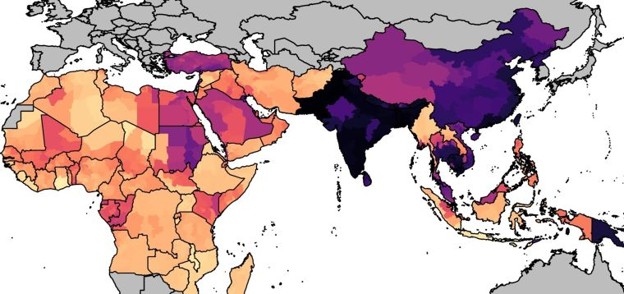
Source: Browne A, Chipeta M, Fell F et al. Estimating the subnational prevalence of antimicrobial resistant Salmonella enterica serovars Typhi and Paratyphi A infections in 75 endemic countries, 1990–2019: a modelling study. The Lancet Global Health, 12, e406-e418
Additional supportive measures
Additional supportive measures for the management of patients with enteric fever may include:
-
Oral or intravenous hydration
-
Acetaminophen
-
Intensive care
-
Appropriate nutrition
-
Blood transfusion
Corticosteroids have historically been suggested for patients with severe enteric fever, which is characterized by delirium, obtundation, stupor, coma or shock though results have been inconsistent with benefits often shown only in specific sub-populations.[12-14] However a recent review suggests the need for larger trials to confirm their utility.[15]
Relapse
The relapse rate is 5% to 10%, even when appropriate therapy has been given.[4] Relapses typically occur 2 to 3 weeks after the resolution of fever and are milder than the initial illness. Cultures, as for the initial illness, should be repeated before commencing antibiotics. The antibiotic susceptibility pattern is typically the same as during the original episode. Depending on the clinical signs and symptoms, further differential diagnoses should also be considered.
Notifying public health and exclusion
Public health authorities must be notified of cases of Salmonella typhi and Salmonella paratyphi infection and determine appropriate management of cases and contacts as mandated in that region. Children and staff in childcare centres are excluded until three consecutive stool cultures, collected at least 48 hours after completion of antibiotic treatment, are negative. Consult local public health directories for infection control and isolation advice as jurisdictional variation exists.
Prevention
Information on prevention is discussed in the Travel-Related Illness section.
Selected resources
-
Fever in the returning child traveller: Highlights for health care providers
-
Public Health Agency of Canada. Typhoid fever. See also, Committee to Advise on Tropical Medicine and Travel (CATMAT). Statement on international travellers and typhoid: An Advisory Committee Statement (ACS). Ottawa (ON): Public Health Agency of Canada; 2014.
-
World Health Organization. Typhoid fever.
References
- Piovani D, Figlioli G, Nikolopoulos G et al. The global burden of enteric fever, 2017–2021: a systematic analysis from the global burden of disease study 2021. eClinicalMedicine, 2024; 77
- Public Health Agency of Canada. Canada Immunization Guide: Evergreen edn. See Pt. 4, Active vaccines.
- Devaranavadagi, R. A., & S., S. (2017). A study on clinical profile of typhoid fever in children. International Journal of Contemporary Pediatrics, 4(3), 1067–1073
- Parry CM, Hien TT, Dougan G, White NJ, Farrar JJ. Typhoid fever. N Engl J Med 2002;347(22):1770-82.
- World Health Organization. WHO laboratory manual for typhoid and paratyphoid (enteric fever). Geneva: World Health Organization; 2026.
- Committee on Infectious Diseases, American Academy of Pediatrics. (2024). Red book: 2024–2027 Report of the Committee on Infectious Diseases (D. W. Kimberlin, R. Banerjee, E. D. Barnett, R. Lynfield, & M. H. Sawyer, Eds.). American Academy of Pediatrics.
- Saha S, Sajib MSI, Garrett D, Qamar FN. Antimicrobial Resistance in Typhoidal Salmonella: Around the World in 3 Days. Clin Infect Dis. 2020 Jul 29;71(Suppl 2):S91-S95.
- GRAM Typhoid Collaborators. Estimating the subnational prevalence of antimicrobial resistant Salmonella enterica serovars Typhi and Paratyphi A infections in 75 endemic countries, 1990-2019: a modelling study. Lancet Glob Health. 2024 Mar;12(3):e406-e418.
- Wang, Y., Xu, X., Jia, S. et al.A global atlas and drivers of antimicrobial resistance in Salmonella during 1900-2023. Nat Commun 16, 4611 (2025). https://doi.org/10.1038/s41467-025-59758-3
- Robinson JL. Salmonella infections in Canadian children. Paediatr Child Health. 2019 Feb;24(1):50-51. doi: 10.1093/pch/pxy199. Epub 2019 Feb 15.
- Trivedi NA, Shah PC. A meta-analysis comparing the safety and efficacy of azithryomycin over the alternate drugs used for treatment of uncomplicated enteric fever. J Postgrad Med 2012;58(2):112-8.
- Hoffman SL, Punjabi NH, Kumala S, et al. Reduction of mortality in chloramphenicol-treated severe typhoid fever by high-dose dexamethasone. N Engl J Med. 1984;310:82–8.
- Punjabi NH, Hoffman SL, Edman DC, et al. Treatment of severe typhoid fever in children with high dose dexamethasone. Pediatr Infect Dis J. 1988;7:598–600.
- Leung DT, Bogetz J, Itoh M, et al. Factors associated with encephalopathy in patients with Salmonella enterica serotype typhi bacteremia presenting to a diarrheal hospital in Dhaka, Bangladesh. Am J Trop Med Hyg. 2012;86:698–702.
- Contopoulos-Ioannidis DG, Ionnidis JP. Claims for improved survival from systemic corticosteroids in diverse conditions: an umbrella review. Eur J Clin Invest 2012 Mar;42(3):233-44
Reviewer(s)
Justin Penner, MD
Last updated: August, 2026